

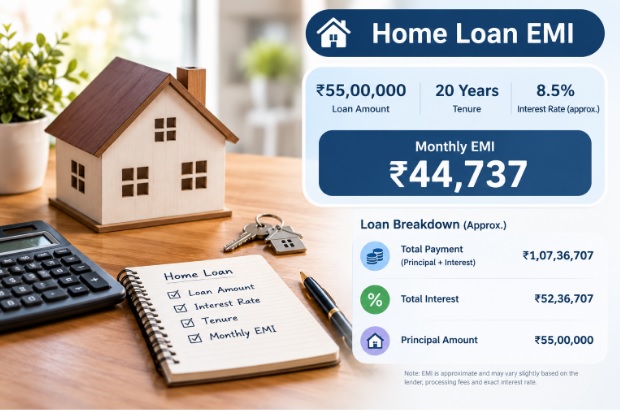
Planning a large home purchase requires careful assessment of both the property price and the financing cost. If you are considering a ₹55 lakh borrowing requirement, the monthly EMI will depend mainly on the interest rate and repayment tenure.
For a 55 lakh home loan for 20 years, the EMI changes when the applicable interest rate changes. Bajaj Markets provides an example of a ₹55 lakh home loan at 8.45% p.a. for 20 years, where the indicative EMI is ₹47,556 and the total interest payable is ₹59,13,440. Actual figures can vary based on the lender and rate offered.
How the EMI Is Calculated
Home loan EMI is calculated using the principal amount, monthly interest rate and number of monthly instalments.
The standard formula is:
EMI = [P × R × (1 + R)^N] / [(1 + R)^N – 1]
Here, P represents the principal, R represents the monthly interest rate and N represents the number of instalments.
For a 55 lakh home loan emi for 20 years, there are 240 monthly installments. A higher interest rate will increase the EMI and total interest payable when the loan amount and tenure remain unchanged.
Why Interest Rate Matters
The interest rate is one of the most important factors affecting home loan affordability. Even a small difference in the rate can influence the total amount paid over two decades.
For example, Bajaj Markets’ ₹55 lakh home loan calculations show different repayment amounts across interest rates and tenures. The figures are indicative and should be checked against the actual offer provided by the lender.
Borrowers should therefore compare the applicable rate rather than relying only on the loan amount.
Impact of a 20-Year Tenure
A 20-year repayment period spreads the principal across 240 months. This can make the monthly payment more manageable than a shorter tenure.
However, a longer tenure means interest continues to accrue for a greater period. In the example available on Bajaj Markets, a ₹55 lakh loan at 8.45% p.a. for 20 years has an indicative EMI of ₹47,556, with total repayment of ₹1,14,13,440.
Home Loan Documents You May Need
Along with repayment planning, borrowers should prepare the documents needed for home loan processing.
Common requirements include identity proof, address proof, income documents, bank statements, photographs, employment details and property-related papers. Salaried applicants may need salary slips, Form 16 and bank statements, while self-employed applicants may need ITRs and financial statements.
The exact documents needed for home loan can vary by lender, borrower category and property type.
How Bajaj Markets Can Help
Bajaj Markets provides home loan information and comparison tools that can help borrowers review available financing options. Current home loan offerings include different interest rates, loan amounts, tenures and processing charges depending on the lender.
Before selecting a lender, compare the EMI, interest rate, processing fee and other applicable charges.
Plan the Loan Carefully
For a 55 lakh home loan emi for 20 years, an EMI should be assessed alongside your monthly income and existing financial commitments. Avoid selecting a repayment amount that leaves little room for regular household expenses or emergencies.
You should also keep the documents needed for home loan ready before submitting the application. Having the required documents needed for home loan organised can help reduce avoidable delays during verification.
A home loan calculator can be used to test different interest rates and tenures. For borrowers considering a 55 lakh home loan for 20 years, this approach can make the long-term repayment obligation easier to understand before making an application.