
Every renovation has a day when things start getting ripped out. The vanity comes off the wall, someone peels up the kitchen lino, and the place finally starts to look like a building site.
That’s usually the day asbestos gets disturbed.
Sydney has a lot of houses where it could be sitting. Think of the fibro cottages around Penrith and Bankstown, the red brick bungalows in Concord, or a Surry Hills terrace where someone added a kitchen and laundry out the back years ago.
When should an asbestos removalist get involved? Well before anyone picks up a hammer.
Why so many Sydney homes are affected
Asbestos was an everyday building material in Australia for most of the 1900s. The national ban only came in at the end of 2003.
After the war, Sydney built with fibro everywhere. It was cheap and fast to put up, and some suburbs were full of fibro houses.
Brick homes aren’t automatically safe. Plenty got fibro later on, when an owner enclosed the back verandah, added a bathroom or built a laundry down the side.
The rough rule is that a home built or renovated before 1990 is the most likely to have it. But age is only a clue. Some old houses test clear, and some newer ones don’t.
Rooms worth a second look
Before demolition, take a slow walk around. These are the spots to note:
- Bathroom and laundry: sheeting behind wall tiles, and sometimes the underlay beneath them
- Kitchen: splashback sheeting and old vinyl or lino floors
- Outside: eaves, cladding, fences, and garage or shed roofs
- Ceilings and roof space: textured ceiling coatings and old pipe insulation
- Meter box: older electrical boards
Looking won’t tell you much. A lot of these old products are hard to tell apart from modern ones, which is why testing matters.
Stage by stage: where the removalist comes in
Planning
Get suspect materials sampled before you sign anything with a builder. The samples go to a NATA accredited laboratory, and you get back a report on what’s there and how much.
Many removalists will book the testing for you. You can also go through an independent licensed assessor.
Quoting
Once the report is in, your asbestos removalist can scope and price the work. A solid quote should list the licence class, the site controls, how the waste is handled and who does the clearance inspection. Get all of that in writing up front and there’s less room for nasty surprises.
Removal day
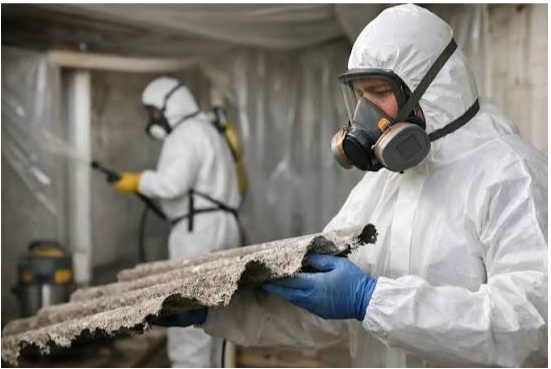
Before the job, the removalist notifies SafeWork NSW. On the day you’ll see signs and an exclusion zone set up around the work area. The crew wets everything down, takes it out carefully, then wraps and labels it.
Clearance
After the clean up, someone inspects the area and issues a clearance certificate. Then your builder can get going again.
Don’t lose that certificate. A certifier may want to see it, and down the track so might a buyer.
Disposal
Asbestos waste can only go to a facility licensed to take it, under NSW EPA rules. Ask for the disposal records and keep them with the certificate.
Class A and Class B, explained simply
There are two kinds of removal licence in NSW.
A Class A licence is needed for friable asbestos. This is the crumbly material that sheds fibres easily, like old pipe lagging.
A Class B licence covers bonded (non friable) asbestos over 10 square metres. That’s where most fibro sheeting fits.
Some jobs need one licence, some need both. Just make sure the removalist you hire is licensed for everything on your site.
“Can’t I just do it myself?”
It’s a question most renovators ask, usually about one small sheet of fibro behind the laundry tub.
The catch is that you can’t see the danger. Snap, cut or sand asbestos and fibres get into the air, then drift around the house and settle in carpet and roof spaces. Mesothelioma and asbestosis, both linked to breathing those fibres in, can take decades to appear.
You also can’t just throw it out. Asbestos isn’t allowed in your household bin or a general skip.
Rules for homeowners vary, so check with SafeWork NSW and your local council first. For most people a licensed professional is simpler, and much safer.
What it means for your budget and timeline
There’s no set price. Cost depends on what kind of asbestos it is, how much there is, how hard it is to get to, and what testing and disposal involve.
Timing is similar. You need to allow for lab turnaround, the notification period, the removal itself and clearance.
The real budget killer is finding asbestos halfway through. The job stops, and every trade booked after that point gets pushed back. Testing early nearly always costs less.
Picking the right removalist
Comparing quotes for asbestos removal Sydney homeowners can trust? Look for a removalist who:
- Holds a current SafeWork NSW licence for the work
- Tells you plainly what’s included
- Explains how your family, pets and neighbours will be protected
- Gives you clearance and disposal paperwork
- Is willing to work with your builder
If one quote is unclear, or a lot lower than the others, ask what’s missing.
Before the crowbar comes out
Got a kitchen, bathroom or full renovation coming up in an older home? Test first, then plan the removal around what you find.
For asbestos removal Sydney wide, get a licensed specialist involved early, while the schedule still has room to move.